
Je bent gecertificeerd. Wat nu?
We’re so excited for this week’s guest blog post written by Pilatesology teacher, Clare Dunphy Hemani!
Your certificate arrives and something shifts. You trained hard, you learned the work, you can teach a session. But here’s what the best teacher trainers will tell you: your training is a floor, not a ceiling. It gives you the foundation to stand on. What you build from there — over years of real bodies, real sessions, real problems — is entirely up to you. Most seasoned educators will tell you it takes a good five years of consistent practice before teaching stops being something you do and starts being something you are.
And yet our industry has a habit of treating certification as the destination. We celebrate graduation, hand over the certificate, and send new teachers out into the world without a roadmap for what comes next. That gap has always existed — but it’s wider now than ever.
The erosion of supervised teaching experience
The rise of online teacher training platforms has made entry into the profession more accessible than ever. But accessibility has come with a quiet trade-off. Many of these platforms have reduced — or in some cases eliminated — the accountability structures around the in-person component of training. And in Pilates education, that component isn’t optional. It’s foundational.
There is simply no substitute for supervised teaching experience. Being in the room with a qualified teacher trainer or supervising instructor who can watch you move, watch you teach, and give you immediate, specific, technical feedback — that is where real learning happens. Hours logged are not the same as hours truly supervised. There’s a significant difference between a teacher who completed their training and a teacher who was genuinely seen, corrected, and challenged throughout it.
That gap may not be obvious to you at first. But it shows up — in the uncertainty of not knowing what you’re looking at when a real body is in front of you, in the reliance on cueing scripts instead of genuine observation, in the feeling that something is missing even when you can’t name it. The good news is that it can be addressed. It just requires intentionality — and knowing where to look.
The landscape is richer than you think
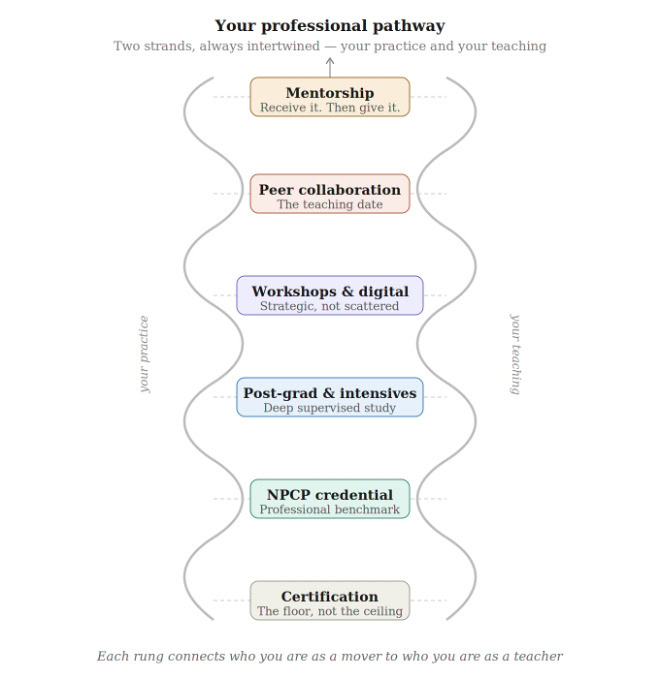
Post-certification pathways exist. They’re just not well signposted. Here’s how to think about them:
Credentialing is the clearest professional benchmark we have. The NPCP certification signals a serious commitment to the field, and the continuing education requirements built into maintaining it create a built-in structure for your ongoing growth. If you haven’t explored it, it’s worth a serious look.
Post-graduate programs, bridge intensives, and extended study with seasoned teachers are where some of the most transformative learning happens. Programs like those offered through Vintage Pilates, The Pilates Center in Boulder, Mejo Wiggin, my own Advanced Seminar, and others create the kind of immersive, apparatus-focused, supervised experience that cannot be replicated on a screen. These aren’t just workshops — they’re structured deep dives with teachers whose knowledge lives in their hands and eyes. If your original training left gaps, these are the places to fill them.
Continuing education workshops have their place too — but approach them strategically. The question isn’t how many hours you’re accumulating. It’s what you’re specifically trying to develop, and whether this experience actually addresses it.
Digital resources — the distinction that matters
Not all online platforms are created equal — and criticizing the erosion of supervised teaching experience is not the same as dismissing the value of digital learning resources.
There is a profound difference between an online platform that replaces your in-person training experience and one that enriches and extends your ongoing development as a teacher. Pilatesology is a perfect example of the latter. The depth and breadth of teachers, lineages, and knowledge that the Pilatesology platform has gathered and preserved over the years is genuinely extraordinary — a resource that no single studio or training program could replicate. Watching a master teacher work, returning to the same video at a different stage of your career and seeing something entirely new — that is a legitimate and valuable part of your continuing education.
The question to ask of any digital resource is simply this: is it replacing the irreplaceable, or is it adding something that couldn’t exist otherwise? The answer tells you everything about how to use it.
The peer-to-peer layer most teachers skip
One of the most underused tools for your growth costs the least: your colleagues. Observation exchanges, study groups, video review with a trusted peer — these create a kind of accountability and honest reflection that solo practice never will. There’s a real difference between talking about your teaching and actually looking at it together. Think of it as a teaching date — equal parts revealing, inspiring, and energizing. It’s one of the best kept secrets in professional development, and the teachers who do it can’t imagine going back. Grab a colleague or two, pick a session, and see what you discover. You might be surprised how much fun it is.
Mentorship in both directions
Here’s where I want to slow down, because there’s a genuine misunderstanding in our community about what mentorship actually is.
Mentorship is not advanced teacher training. It’s not taking more classes or finding someone to give you the answers. It’s a relationship built around inquiry, reflection, and growth that unfolds over time. A true mentor doesn’t fix your teaching. They help you see it.
If you feel those gaps, especially if your training was light on supervised hours, finding an experienced mentor for one-on-one work can be the single most impactful investment you make. Not another workshop. Not another credential. A relationship.
But there’s a second direction to mentorship that you may never have considered: learning to be a mentor yourself. The skills involved are learnable, and developing them will deepen your own teaching in ways that nothing else will. They also open a distinct professional chapter for studio owners, teacher trainers, workshop providers, and experienced teachers ready to play a bigger role in this field. It’s a subject I’ve been sitting with for a long time, and in January 2027 Handspring Publishing will release my book Pilates Handbook: Tools for Developing Your Skills as a Teacher — a practical guide to self-assessment, peer feedback, and mentorship as an ongoing practice, for teachers across every Pilates tradition.
This is the conversation I want to open. I want you in the room.
Join me live on Zoom. Friday, May 29, 2026. Mentorship as a Skill: A Conversation for Experienced Teachers
Two sessions available:
• 8:00 AM EST / 2:00 PM CET: best for European participants
• 2:00 PM EST / 11:00 AM PT: best for US & Canada participants
Register even if you can’t attend live. The recording goes to everyone who signs up. This is an open conversation. Come ready to think out loud, whether that’s about a role you’re stepping into or just a pull toward something you can’t quite name yet.
Your training gave you the floor. This is about everything you build above it.

About Clare
Clare Dunphy Hemani BS, NCPT is a world-renowned Pilates educator, mentor, and author based in Newburyport, Massachusetts, where she founded Progressive Bodyworks. A multi-sport athlete who earned a full lacrosse scholarship to Northeastern University, Clare spent 18 years as a personal trainer before a pivotal moment in 1995 changed everything. Walking into Drago’s Gym in New York City, she encountered Romana Kryzanowska and discovered a completely different understanding of what movement and teaching could be.
Clare has since deepened her work through decades of study with many teachers. She co-authored the Peak Pilates Comprehensive Education Program, developing teachers and trainers worldwide. Her studio is a destination for teachers seeking to go deeper — through her Elevate monthly workshops, her Advanced Seminar: Mastering the Art of Teaching, and her online studio PilatesAvatar.com.
Her forthcoming book, Pilates Handbook: Tools for Developing Your Skills as a Teacher (Handspring Publishing, January 2027), distills decades of mentoring into a practical guide for teachers at every stage of their career.
Committed to preserving the authenticity of the method, Clare’s approach is refreshing, generous, and shaped by decades of practice — and the understanding that the best teachers never stop being students.
Bezoek Clare op progressivebodyworksinc.com.
Tags:

Van de gemeenschap